
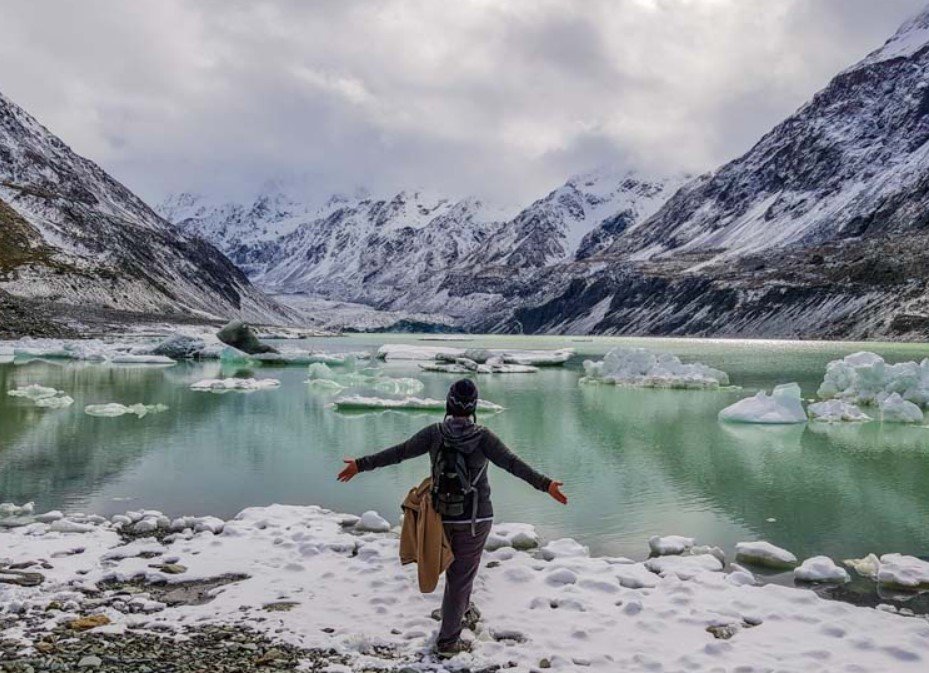
Hooker Valley is an alpine valley in Aoraki/Mount Cook National Park on New Zealand’s South Island. Surrounded by some of the Southern Alps’ most dramatic mountains, the valley follows the Hooker River toward Hooker Lake and the glaciers beneath Aoraki/Mount Cook. Its combination of glacial scenery, alpine vegetation, rivers, lakes, and towering peaks makes it one of New Zealand’s most recognizable mountain landscapes.
The valley is best known for the Hooker Valley Track, a popular walking route that leads from White Horse Hill toward Hooker Lake. Along the way, visitors encounter suspension bridges, glacial terrain, mountain viewpoints, and changing views of Aoraki/Mount Cook and the surrounding Southern Alps.
Hooker Valley Quick Facts
| Fact | Details |
|---|---|
| Location | Aoraki/Mount Cook National Park, South Island |
| Country | New Zealand |
| Region | Canterbury |
| Setting | Southern Alps / Kā Tiritiri o te Moana |
| Main River | Hooker River |
| Famous For | Hooker Valley Track, alpine scenery and views of Aoraki/Mount Cook |
| Climate | Cool, wet alpine climate |
| Best Months | Generally November to April |
| Nearby Town | Aoraki/Mount Cook Village |
Where Is Hooker Valley?
Hooker Valley is located within Aoraki/Mount Cook National Park in the Canterbury region of New Zealand’s South Island. It lies immediately west of Aoraki/Mount Cook Village and extends north toward Hooker Lake and the Hooker Glacier.
The valley is reached from the village via Hooker Valley Road, which ends at the White Horse Hill car park. The nearest larger settlements include Twizel and Lake Tekapo, both of which are commonly used as bases for reaching the Aoraki/Mount Cook area.
Geography and Landscape
The valley is a long alpine corridor surrounded by the Southern Alps. The Hooker River runs through its floor, carrying glacial meltwater toward the wider Mackenzie Basin. The landscape includes tussock-covered slopes, moraine deposits, rocky riverbeds, alpine vegetation, glacial lakes, and steep mountain faces.
Aoraki/Mount Cook dominates the wider landscape and is New Zealand’s highest mountain. Other prominent peaks around the valley include Mount Sefton and the surrounding peaks of the Aoraki/Mount Cook massif.
Hooker Lake lies at the upper end of the main walking route and receives water from the Hooker Glacier. Icebergs can sometimes be seen floating in the lake during the warmer months.
History of Hooker Valley
Hooker Valley has deep cultural significance for Ngāi Tahu, the principal Māori iwi of New Zealand’s South Island. Aoraki and the surrounding mountains are central to Ngāi Tahu traditions, and the national park landscape has formal cultural protections reflecting its importance.
European interest in the valley increased during the nineteenth century as explorers, mountaineers, and visitors began traveling into the Aoraki/Mount Cook region. The Hooker and Mueller Valleys were formally gazetted as a recreation reserve in 1885, reflecting growing interest in preserving the area while allowing public access.
Mount Cook National Park was established in 1953, helping protect the valley and surrounding alpine landscapes. Tourism and mountaineering subsequently became important parts of the region’s identity, with walking tracks providing easier access to scenery that was once considerably harder to reach.
How Was Hooker Valley Formed?
Hooker Valley was shaped primarily by glacial processes. During past ice ages, large glaciers moved through the valley, eroding and widening the surrounding rock and creating the broad U-shaped alpine landscape.
Glacial movement, erosion, rockfall, and the continuing action of meltwater have continued to modify the valley. Moraine deposits and glacial lakes provide visible evidence of the area’s changing ice environment.
Hooker Valley Weather Throughout the Year
Hooker Valley has an alpine climate characterized by rapidly changing conditions. Rain, strong winds, snow, low cloud, and sudden temperature changes can occur at any time, even when conditions appear settled at the start of a walk.
January to March
Summer provides some of the mildest conditions, with longer daylight hours and generally better opportunities for walking. Temperatures remain cool compared with lowland New Zealand, and afternoon weather can change quickly.
April to June
Autumn brings cooler temperatures and increasing chances of rain and snow. Higher mountain areas can become wintry before the valley floor, and visitors should be prepared for changing conditions.
July to September
Winter is cold, with snow and ice common throughout the alpine environment. Parts of the walking track can become icy, while heavy snowfall and strong winds can affect access. Proper winter footwear and warm, waterproof clothing are important.
October to December
Spring brings gradually improving conditions, although snow, rain, and strong winds can still occur. The landscape begins to transition toward summer, with longer days and increasing alpine plant activity.
Best Weather for Visiting Hooker Valley
November through April generally offers the most convenient conditions for exploring the valley, particularly for visitors interested in walking the Hooker Valley Track. Even during summer, alpine weather can change rapidly, so forecasts and local track conditions should always be checked before setting out.
Things to Do in Hooker Valley
- Walk the Hooker Valley Track: Follow the valley toward Hooker Lake while enjoying changing views of the surrounding mountains and glaciers.
- Photography: The valley provides exceptional opportunities for photographing mountains, rivers, glaciers, lakes, and alpine vegetation.
- Mountain sightseeing: View Aoraki/Mount Cook and other Southern Alps peaks from the valley floor and designated viewpoints.
- Wildlife watching: Look for alpine birds and other native species while walking through the valley.
- Stargazing: The remote alpine environment and dark skies around Aoraki/Mount Cook provide excellent conditions for observing the night sky.
- Short scenic walks: Nearby routes such as the Kea Point Track provide additional opportunities to experience the surrounding mountain environment.
Famous Attractions in and Around Hooker Valley
Hooker Valley Track
The valley’s best-known attraction is its walking track from White Horse Hill toward Hooker Lake. The route crosses several suspension bridges and passes through glacial terrain.
Hooker Lake
Located at the upper end of the track, Hooker Lake provides views toward the surrounding glaciers and Aoraki/Mount Cook. Floating icebergs may be visible during warmer periods.
Aoraki/Mount Cook
New Zealand’s highest mountain forms the dramatic backdrop to the valley and is one of the defining landmarks of the region.
Mueller Lake
This glacial lake lies below the Mueller Glacier and can be viewed from sections of the Hooker Valley Track and nearby viewpoints.
Mount Sefton
Mount Sefton rises prominently beside the valley and is recognizable for its steep alpine slopes and extensive snow and ice.
White Horse Hill
White Horse Hill is the main starting area for the Hooker Valley Track and several other walks in the vicinity.
Alpine Memorial
Located near the beginning of the walking route, the memorial commemorates climbers and mountaineers who lost their lives in the Aoraki/Mount Cook region.
Wildlife and Nature
Hooker Valley forms part of a protected alpine ecosystem containing tussock grasslands, native shrubs, flowering alpine plants, glacial rivers, and rocky habitats. One notable plant is the Mount Cook buttercup, also known as kōpukupuku, a large alpine buttercup associated with the Aoraki/Mount Cook region.
Native birds can also be encountered in the area. Kea, New Zealand’s alpine parrot, is one of the most distinctive species visitors may see or hear. The New Zealand falcon, or kārearea, also occurs in the wider region.
The valley’s natural environment is protected within Aoraki/Mount Cook National Park, where conservation work focuses on protecting native ecosystems, landscapes, and culturally significant places.
How to Reach Hooker Valley
Hooker Valley is easiest to reach by road. From Aoraki/Mount Cook Village, visitors follow Hooker Valley Road for approximately five minutes to reach White Horse Hill car park, where the main walking route begins.
Aoraki/Mount Cook Village can be reached via State Highway 80 from the direction of Twizel. Twizel is approximately 50 minutes away by car, while Lake Tekapo is around 1.5 hours away under normal conditions.
Snow can affect State Highway 80 during winter, so road conditions should be checked before traveling. The White Horse Hill car park also has paid parking.
Where to Stay Near Hooker Valley
The most convenient accommodation is in Aoraki/Mount Cook Village, where visitors can find hotels, lodges, backpacker accommodation, and other visitor facilities.
Camping is available at White Horse Hill, close to the start of the Hooker Valley Track. Travelers looking for a wider selection of accommodation can also stay in Twizel or Lake Tekapo, although these locations require a longer drive to reach the valley.
Why Is Hooker Valley Famous?
Hooker Valley is famous for its spectacular alpine setting and its easy access to some of New Zealand’s most dramatic mountain scenery. The combination of the Hooker River, glacial lakes, suspension bridges, alpine vegetation, glaciers, and views toward Aoraki/Mount Cook makes it a standout destination within Aoraki/Mount Cook National Park.
Hooker Valley FAQs
Where is Hooker Valley located?
Hooker Valley is in Aoraki/Mount Cook National Park in Canterbury on New Zealand’s South Island. It begins near Aoraki/Mount Cook Village and extends toward Hooker Lake.
What is Hooker Valley famous for?
It is best known for the Hooker Valley Track, alpine scenery, glacial landscapes, and views of Aoraki/Mount Cook.
What is the weather like in Hooker Valley?
The climate is cool and changeable. Rain, snow, strong winds, and sudden temperature changes are possible throughout the year.
What are the best months to visit Hooker Valley?
November through April generally provides the most convenient conditions for walking, although weather can change quickly even during summer.
What can you do in Hooker Valley?
Walking, photography, sightseeing, wildlife observation, and stargazing are among the main activities available in and around the valley.
How do you reach Hooker Valley?
The valley is reached by driving to White Horse Hill car park via Hooker Valley Road from Aoraki/Mount Cook Village.
Does Hooker Valley get snow?
Yes. Snow is common during winter and can occur at other times of year in the surrounding alpine environment.
How long is the Hooker Valley Track?
The full track from White Horse Hill to Hooker Lake is approximately 10 km return, although walking times can vary according to conditions and individual pace.
Final Thoughts
Hooker Valley offers an accessible introduction to the alpine landscapes of Aotearoa New Zealand. Its combination of glaciers, rivers, mountain peaks, native wildlife, and dramatic scenery makes it an excellent destination for visitors interested in nature, walking, photography, and the Southern Alps.
For More Visit Stay And Update
