
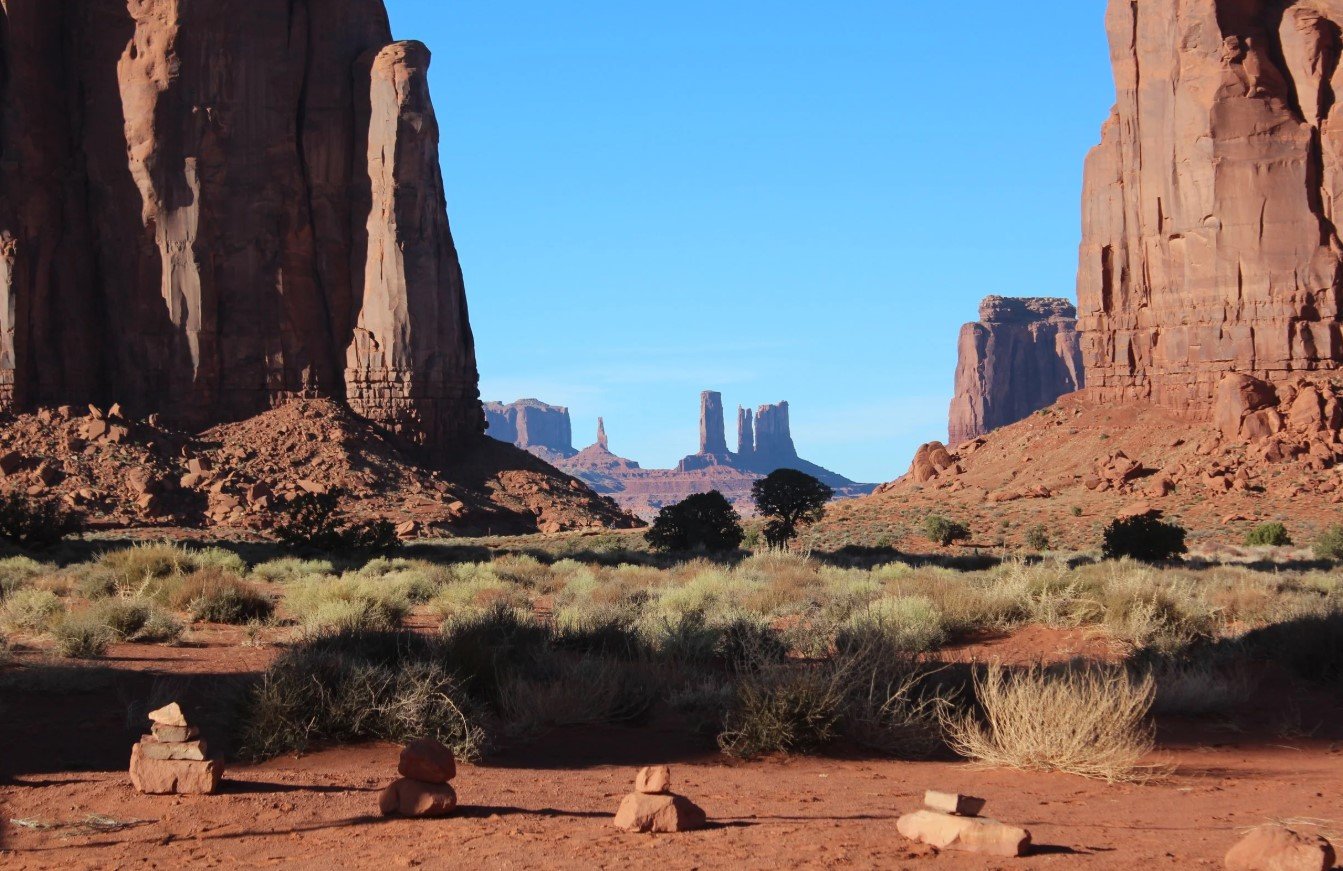
Monument Valley is a striking desert valley on the Arizona-Utah border, recognized for its towering sandstone buttes, mesas, wide-open horizons, and deep connection to Navajo culture. Unlike a conventional valley shaped by rivers or glaciers, this landscape is defined by isolated rock formations rising dramatically from the surrounding Colorado Plateau.
Much of the area is protected as Monument Valley Navajo Tribal Park, managed by the Navajo Nation. Its scenery has appeared in countless photographs, films, and television productions, but the valley is more than a famous desert backdrop. It is a culturally important landscape and a place where geology, Indigenous heritage, and tourism intersect.
| Fact | Details |
|---|---|
| Location | Arizona-Utah border |
| Country | United States |
| Region | Colorado Plateau |
| Elevation | About 5,500–6,000 feet in the valley area |
| Famous For | Sandstone buttes, mesas and Navajo culture |
| Climate | High-desert, semi-arid climate |
| Main Landscape | Sandstone formations, desert plains and mesas |
| Best Months | April–May and September–October |
| Nearby Towns | Kayenta, Arizona; Oljato-Monument Valley, Utah |
Where Is Monument Valley?
Monument Valley lies along the Arizona-Utah border within the Navajo Nation. The most famous portion is Monument Valley Navajo Tribal Park, whose visitor center is on the Utah side near Oljato-Monument Valley. Kayenta, Arizona, is the nearest larger community and an important service center for travelers.
U.S. Route 163 passes through the broader Monument Valley region, providing the main road connection between communities in northeastern Arizona and southeastern Utah. The valley is also within driving distance of other major Four Corners attractions, including Four Corners Monument and Canyon de Chelly.
Geography and Landscape
The landscape is dominated by enormous sandstone buttes, mesas, cliffs, desert plains, and scattered vegetation. Some of the most recognizable formations rise hundreds of feet above the valley floor, creating the dramatic vertical scenery associated with Monument Valley. The Navajo Nation describes the park’s sandstone formations as reaching approximately 400 to 1,000 feet above the surrounding landscape.
The valley sits within the Colorado Plateau, a region characterized by broad uplands and deeply eroded sedimentary rock. Wind and water have gradually removed softer surrounding material, leaving harder sandstone formations standing as isolated monuments. Their reddish and orange tones come from iron-rich minerals within the rock.
Rather than having a large permanent river running through its center, the landscape is shaped primarily by dry washes, seasonal rainfall, erosion, and wind. Sand accumulates around rock formations and in lower areas, adding another layer to the desert environment.
History of Monument Valley
Monument Valley has a long Indigenous history and remains part of the Navajo Nation. Navajo people have longstanding cultural connections to the surrounding land, and the landscape continues to have spiritual, cultural, and economic importance. Visitors should recognize that the valley is tribal land rather than a conventional national park. Navajo Nation Parks & Recreation manages the tribal park with an emphasis on protecting natural and cultural resources for the Navajo people.
The valley became increasingly known to outsiders during the twentieth century, particularly after filmmaker John Ford used its distinctive scenery in Western movies. Films shot in and around the region helped establish Monument Valley as an iconic image of the American Southwest.
Tourism subsequently became an important part of the local economy. Today, Navajo-operated tours provide visitors with opportunities to explore areas that are not accessible through the standard scenic route while learning about the area’s landscape and cultural heritage.
How Was Monument Valley Formed?
Monument Valley’s distinctive formations developed through long periods of sediment deposition, uplift, weathering, and erosion. Ancient environments deposited layers of sand and other sediments that eventually hardened into sandstone.
Later uplift raised the Colorado Plateau, while wind and water gradually wore away the softer surrounding rock. Harder sandstone layers resisted erosion more effectively, leaving behind mesas and isolated buttes. Over millions of years, this process produced the enormous formations visible today.
The landscape therefore represents an ongoing process rather than a single geological event. Erosion continues to reshape the cliffs, slopes, and desert floor.
Monument Valley Weather Throughout the Year
Monument Valley has a high-desert climate with large temperature differences between day and night. Summers can be hot, while winters are cold and can occasionally bring snow. Spring and autumn generally offer more moderate conditions.
January to March
Winter and early spring are cool, with cold nights and mild to cool daytime temperatures. Snow is possible during winter storms, and the surrounding red-rock formations can look particularly dramatic when dusted with snow.
April to June
Spring brings warmer days and generally comfortable conditions for sightseeing. April and May are among the most pleasant periods for outdoor exploration, while June becomes noticeably hotter as summer approaches.
July to September
Summer is hot during the day, although the valley’s elevation keeps conditions somewhat different from lower desert areas. Afternoon thunderstorms can occur during the summer monsoon season, sometimes producing sudden rain, lightning, and strong winds.
October to December
Autumn temperatures gradually become cooler, making October particularly comfortable for exploring. November and December bring colder nights, and winter weather becomes increasingly possible toward the end of the year.
Best Weather for Visiting Monument Valley
April, May, September, and October generally provide a good balance of moderate daytime temperatures and suitable conditions for sightseeing. Spring can also bring changing desert colors and clear views, while autumn offers cooler conditions without the harshest summer heat.
Things to Do in Monument Valley
Drive the Scenic Valley Route
The Monument Valley scenic drive provides access to major viewpoints and formations. The route is unpaved and can contain rough sections, so visitors should follow current Navajo Tribal Park rules and vehicle restrictions.
Take a Navajo-Guided Tour
Guided tours provide access to parts of the landscape that visitors cannot independently explore and add cultural context to the scenery.
Photograph the Rock Formations
The changing sunlight creates strong contrasts across the sandstone formations, making sunrise, sunset, and changing cloud conditions especially popular for photography.
Explore Designated Hiking Areas
Visitors can hike on designated routes where permitted. Some areas require permits or guides, so travelers should check current tribal park regulations before setting out.
Learn About Navajo Culture
Guided experiences can introduce visitors to local traditions, stories, crafts, and the cultural significance of the landscape.
Enjoy Stargazing
The remote setting and limited development provide opportunities to view the night sky far from major urban centers.
Famous Attractions in and Around Monument Valley
Mittens and Merrick Butte
The East and West Mittens are among the valley’s most recognizable formations. Merrick Butte stands nearby and contributes to the classic Monument Valley skyline.
John Ford’s Point
Named for filmmaker John Ford, this viewpoint overlooks a broad section of the valley and is closely associated with the area’s cinematic history.
Artist’s Point
This viewpoint provides a broad perspective across the valley’s sandstone formations and is particularly attractive when sunlight creates strong shadows across the landscape.
Elephant Butte
Elephant Butte is a distinctive sandstone formation whose shape resembles an elephant, adding another recognizable landmark to the valley.
Three Sisters
Three tall rock spires rise together from the surrounding landscape, creating one of the area’s notable geological formations.
Monument Valley Visitor Center
The visitor center provides information about the tribal park, its landscape, visitor regulations, and guided-tour opportunities.
Forrest Gump Point
Located along U.S. 163 outside the main tribal park, this roadside viewpoint became famous after appearing in the movie Forrest Gump and offers a memorable view toward the Monument Valley formations.
Wildlife and Nature
Monument Valley’s desert ecosystem supports plants and animals adapted to limited water, intense sunlight, and large temperature changes. Desert shrubs, grasses, juniper, and other drought-tolerant vegetation occur across the landscape.
Wildlife in the broader region includes mule deer, coyotes, jackrabbits, desert rodents, reptiles, and numerous bird species. The sparse vegetation means animals can be easier to spot during quieter periods, particularly in the cooler morning and evening hours. Protecting fragile desert vegetation and avoiding disturbance to wildlife are important parts of responsible visitation.
How to Reach Monument Valley
The main approach is by road. U.S. Route 163 runs through the Monument Valley region, while Arizona State Route 163 and surrounding highways connect travelers with communities such as Kayenta and Mexican Hat.
The nearest commercial airports are generally in larger regional cities such as Flagstaff, Arizona, and Durango, Colorado, although both require a substantial road journey. Because public transportation options in the immediate valley are limited, most independent visitors arrive by car.
The scenic valley drive has specific operating rules, and current conditions should be checked before visiting. The Navajo Nation advises that the 17-mile valley drive has rough terrain and deep sand, with certain larger vehicles prohibited from using the route.
Where to Stay Near Monument Valley
Accommodation is available in and around Oljato-Monument Valley and nearby Kayenta. Options include hotels, lodges, cabins, bed-and-breakfast properties, campgrounds, and RV facilities.
Staying close to the tribal park is convenient for visitors interested in sunrise photography and early tours. Kayenta provides a wider selection of everyday services, while camping and other outdoor accommodation options are available for travelers who prefer to remain closer to the landscape.
Why Is Monument Valley Famous?
Monument Valley is famous for its towering red sandstone buttes and mesas, distinctive desert scenery, Navajo cultural heritage, and major role in the visual history of Western cinema. Its instantly recognizable formations have become one of the defining symbols of the American Southwest.
Monument Valley FAQs
Where is Monument Valley located?
Monument Valley is located on the Arizona-Utah border within the Navajo Nation. The principal tribal park area is near Oljato-Monument Valley, Utah.
What is Monument Valley famous for?
It is famous for its enormous sandstone buttes, mesas, desert landscapes, Navajo cultural heritage, and appearances in numerous films.
What is the weather like in Monument Valley?
The area has a high-desert climate with hot summers, cold winters, and significant temperature differences between day and night.
What are the best months to visit Monument Valley?
April, May, September, and October generally offer comfortable conditions for sightseeing and outdoor activities.
What can you do in Monument Valley?
Popular experiences include scenic driving, Navajo-guided tours, hiking in designated areas, photography, cultural experiences, and stargazing.
How do you reach Monument Valley?
Most visitors drive to the valley using regional highways, with U.S. Route 163 providing one of the principal approaches.
Does Monument Valley get snow?
Yes. Snow can occur during winter, although accumulation varies. A light layer of snow can create a striking contrast against the area’s red sandstone.
Is Monument Valley in Arizona or Utah?
It is associated with both states because the valley lies along the Arizona-Utah border. Monument Valley Navajo Tribal Park’s visitor center and principal scenic area are on the Utah side.
Final Thoughts
Monument Valley is a distinctive landscape where towering sandstone formations, desert ecology, Navajo heritage, and cinematic history come together. Its combination of dramatic scenery and cultural significance makes it valuable not only as a destination for sightseeing and photography but also as a place to understand the natural and human history of the American Southwest.
For More Visit Stay And Update
